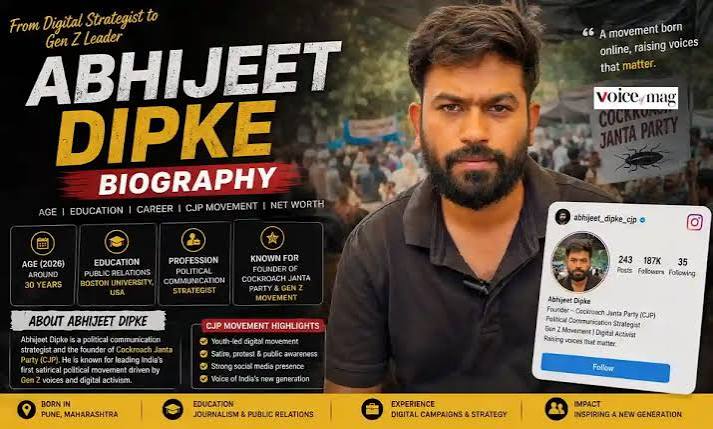
Abhijeet Dipke Biography: The Story Behind the Cockroach Janta Party Movement
In 2026, social media once again demonstrated its ability to turn a simple idea into a nationwide conversation. One of the most unusual examples was the rise of the Cockroach Janta Party (CJP), a satirical digital movement associated with young Indians and issues such as unemployment, education and examination-related concerns.
At the centre of this movement is Abhijeet Dipke, a Maharashtra-based public communicator who became widely known after a satirical social-media post inspired the creation of the Cockroach Janta Party. What began as internet satire quickly developed into a much larger youth movement.
Name: Abhijeet Dipke
Known for: Founder of the Cockroach Janta Party movement
Background: Journalism and Public Relations
Education: Journalism studies in Pune and a Master's in Public Relations from Boston University's College of Communication
Movement: Cockroach Janta Party (CJP)
Who Is Abhijeet Dipke?
Abhijeet Dipke became a prominent public figure in India in 2026 after launching the Cockroach Janta Party as a satirical digital initiative. Reports describe him as someone with a background in journalism and public relations, giving him experience in communication, social media and public messaging.
According to Boston University's College of Communication, Dipke completed his master's degree in public relations there in 2025. The university also described how his social-media post about bringing "cockroaches" together developed into a much larger online movement.
Education and Communication Background
Dipke studied journalism in Pune before pursuing higher education in the United States. His master's education in public relations at Boston University's College of Communication gave him an academic background in communication and public engagement.
His experience in journalism and public relations is particularly relevant to the way the CJP developed. Instead of relying only on conventional political communication, the movement used social media, memes, graphics, online campaigns and direct digital engagement to reach a younger audience.
How Did the Cockroach Janta Party Begin?
The story of the Cockroach Janta Party began in May 2026 after remarks made by Chief Justice of India Surya Kant during a court hearing became the subject of widespread online discussion.
During the hearing, the Chief Justice referred to certain young people involved in media, social media and activism as "cockroaches" while discussing the issue before the court. The remarks subsequently generated controversy and online reactions. The Chief Justice later said that his observations had been misrepresented and provided additional context about what he intended to convey.
Against this backdrop, Abhijeet Dipke posted on social media asking what would happen if the "cockroaches" came together. The post quickly gained attention and became the starting point for the Cockroach Janta Party.
The idea was initially presented as satire, but its message connected with many young people who were frustrated about unemployment, education and wider concerns about the system.
From Internet Satire to a Large Youth Movement
The response to Dipke's post was much larger than a typical social-media joke. According to Boston University's account of the movement, the CJP's initial online sign-up attracted tens of thousands of people within its first day and grew rapidly during the following days.
The movement also attracted considerable attention on Instagram and other digital platforms. Its communication style relied heavily on humour, satire and internet culture, making it particularly accessible to younger audiences.
What made the CJP unusual was the way it combined a humorous identity with serious public issues. Instead of presenting itself only as an internet joke, the movement began discussing unemployment, examination problems, education reforms and accountability.
Why the Name "Cockroach Janta Party"?
The unusual name came directly from the controversy surrounding the "cockroach" remark. Rather than treating the word only as an insult, the movement turned it into a symbol of resilience and collective identity.
This strategy is one reason the CJP attracted attention so quickly. The name was memorable, easy to use in social-media campaigns and closely connected to the event that inspired its creation.
The CJP's Focus on Youth Issues
Although the movement began through satire, its public campaigns have increasingly focused on issues affecting students and young people.
- Education reforms: Greater transparency and accountability in the education system.
- Examination concerns: Public attention to alleged examination irregularities and paper-leak issues.
- Unemployment: Highlighting concerns surrounding employment opportunities for young people.
- Student welfare: Supporting students who raise concerns about education and examinations.
- Public accountability: Encouraging institutions and authorities to respond to public concerns.
In August 2026, CJP leaders discussed expanding the movement across India and building a nationwide network of student organisations. Education reforms and examination transparency remained central to the organisation's stated plans.
CJP and the Jantar Mantar Protest
One of the movement's most significant moments came with its involvement in a major student protest at Delhi's Jantar Mantar in June 2026.
Abhijeet Dipke emerged as one of the prominent faces of the campaign. The protest focused on concerns surrounding examinations, education and alleged irregularities. The event helped move the CJP's visibility beyond social media and into national public discussion.
The movement subsequently remained active around education-related issues and continued to use social media as one of its primary communication channels.
Legal and Social-Media Controversies
The CJP's rapid growth was accompanied by controversy surrounding its online presence. In May 2026, the movement said that its website and social-media accounts had been taken down or restricted.
Its X account was also withheld in India following a legal demand. The issue later reached the Delhi High Court, which in July 2026 directed that the account be unblocked after the examination-related concerns cited in the case had changed.
These developments highlighted the complicated relationship between fast-growing digital movements, social-media platforms and government or legal processes.
Is the Cockroach Janta Party a Political Party?
This is an important distinction when discussing the CJP.
Despite its name, the organisation has not announced an immediate move into conventional electoral politics. In August 2026, Abhijeet Dipke said that the CJP intended to continue functioning as a pressure group rather than becoming a traditional political party.
The organisation has instead focused on building a broader public movement and supporting issues raised by students and citizens. Its leaders have also discussed expanding the movement nationally.
"Kya Bolti Public" Campaign
In August 2026, Abhijeet Dipke announced a nationwide public outreach campaign called "Kya Bolti Public."
The campaign was presented as an effort to understand people's concerns and expectations across different parts of India. According to reports, the initiative was expected to focus on issues including unemployment, education reforms and social justice.
This development marked a shift from the CJP's original internet-focused satire toward broader public engagement and grassroots outreach.
Why Has Abhijeet Dipke Become So Popular?
Several factors have contributed to Dipke's rapid rise in public attention.
1. Digital Communication
Dipke understood how quickly a simple message could spread through social-media platforms. The CJP's use of humour, memes and short-form digital content helped it reach a large audience.
2. Youth-Focused Messaging
The movement focused on issues that are particularly important to students and young people, including employment, examinations and education.
3. A Memorable Identity
The unusual "cockroach" identity made the movement instantly recognisable. It also allowed supporters to participate in a shared online culture.
4. From Satire to Public Action
The movement did not remain limited to memes and social-media posts. Its involvement in public demonstrations and discussions about education helped it gain wider attention.
Abhijeet Dipke's Earlier Political Association
Some media reports have also discussed Dipke's earlier association with the Aam Aadmi Party's social-media activities. This has led to questions about the political independence of the CJP.
However, the CJP has presented itself as an independent movement. Claims about political affiliations should therefore be distinguished from verified organisational positions and should not be presented as proof that the CJP is controlled by another political party.
The Future of the Cockroach Janta Party Movement
The future of the CJP remains uncertain. Its current leadership has indicated that it wants to operate as a pressure group rather than immediately contest elections.
In August 2026, the organisation discussed a nationwide expansion and a network of student groups. It also announced plans to engage with people across different parts of India through the "Kya Bolti Public" campaign.
Whether the movement eventually enters electoral politics is a question for the future. For now, its stated direction is focused on public engagement, education-related issues, student concerns and accountability.
Conclusion
Abhijeet Dipke's rise is an unusual example of how social media can transform satire into a major public movement. What began with a short post in May 2026 developed into the Cockroach Janta Party, attracting widespread attention from young Indians and national media.
The movement's identity remains unconventional, but its growing focus on education, examinations, unemployment and public accountability has given it a more serious public role.
For now, the CJP is best understood not as a conventional electoral party but as a youth-oriented digital movement and pressure group. Its future will depend on whether it can turn online popularity into sustained grassroots participation and constructive public engagement.
Sources & Further Reading
Disclaimer: This article is provided for informational and educational purposes. It has been prepared using publicly available reports and official university information. Political developments can change over time, so readers should consult the linked sources for the latest updates. This article does not represent the views of any political organisation or candidate.